
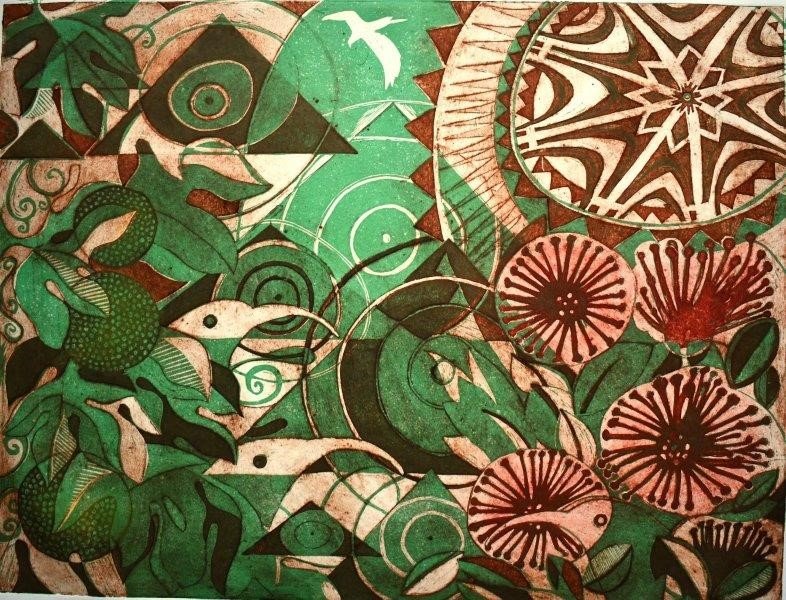
E komo pū ana mākou / We enter anyway: Contemporary indigenous art, between resistence and risk
This essay reflects on the contradictions and responsibilities Indigenous artists and educators navigate within contemporary institutions. Drawing on the metaphors of the double-edged sword and the Trojan horse, I explore how Indigenous visual art practice affirms cultural knowledge while simultaneously confronting the risks of institutional framing, containment, and commodification. Through critical reflection and personal narrative—including my early work at the University of Hawai‘i and my current teaching at OCAD University—I examine the tensions between visibility and sovereignty, inclusion, and integrity. I argue that Indigenous presence within galleries, universities, and museums must not be mistaken for structural transformation. Authentic engagement requires a grounding in cultural protocol, kuleana (responsibility), and moʻokūʻauhau (genealogy). Despite the risks, we continue to enter these spaces—because our stories are not static, and our knowledge must remain in motion.
Double-edged sword and the Trojan Horse
Contemporary Indigenous art practice is both a double-edged sword and a Trojan horse. We enter spaces—galleries, classrooms, biennials, institutions—not out of naivety, but out of necessity. As Indigenous artists, we move through systems that were never built for us, carrying knowledge that predates their foundations. We come bearing our stories, our ancestors, our protocols. We do so with purpose: to make space for our communities to see themselves, to remember what has been suppressed, to return our truths to the centre of visual and conceptual worlds. But doing so requires navigating structures that demand translation, performance, or concession. We say our work is ceremony in motion. And it is. But only to the extent that the gallery, the market, the museum, or the collector can understand—or tolerate. The sacred becomes aesthetic. The layered becomes symbolic. Protocol becomes narrative. In this framing, the living knowledge we carry can be flattened—palatable, collectible, safe.
The double edge is this: the same systems that welcome our presence also shape our reception. The same exhibitions that claim to celebrate Indigenous resurgence may simultaneously disarm its power. The very visibility we seek—for our people, our teachings, our ways of seeing—can become a site of containment, consumption, or silence. And still—we enter. Not because we are unaware of the risks. But because we hold something older than the institution, and more enduring than the frame. We enter because our stories demand movement. Because our knowledge lives in the telling, the making, the seeing. Because we were never meant to be still.
The Dilemma of Visibility / E nānā i ke kumu – Look to the source.
This is what Indigenous artists ask, again and again, as our work enters the white-walled spaces of museums, biennials, and lecture halls. Look not just at what is shown—but to what grounds it. See the lineage, not just the line. Feel the protocol behind the pigment. Hear the voices inside the image. And yet, more often than not, the framing of our work stops short of the source. It favours the aesthetic over the ancestral, the symbolic over the sacred. It asks us to make ourselves visible—but only in ways legible to audiences, institutions, and markets unfamiliar with or resistant to our full context. Visibility becomes conditional. The artist becomes both guide and translator—shaping their work not only for expression, but for reception. We are asked to be accessible, explainable, collectible. As Dylan Robinson writes, this is a form of “hungry listening”—a kind of consumption that satisfies the listener without transforming them. In the visual realm, this hunger becomes a gaze. The image is taken in, but the knowledge is left behind. Leanne Simpson reminds us that misrecognition is not just misunderstanding—it is a tactic. It allows settler institutions to claim inclusion while sidestepping true engagement. Candice Hopkins has called out the aesthetics of inclusion as surface-deep gestures that leave deeper structures unchanged. In these spaces, we begin to feel the edge again. The double-edged sword. The Trojan horse. We are invited in—but only on terms that mute the full story of what we carry.
E komo pū ana mākou / And Still—We Enter
Not because we are unaware of the cost. Not because we mistake inclusion for transformation But because we are guided by kuleana—the deep, reciprocal responsibility to carry forward the knowledge and presence of our people. To enter is not a passive act. It is strategic. Considered. Often contested. We weigh the risks each time: Will our work be framed appropriately? Will it be asked to perform identity? Will it be extracted or honoured? These are not just personal questions; they are pedagogical and political ones. They shape how Indigenous knowledge moves—or is prevented from moving—within institutions that claim to welcome it.
As Indigenous artists and educators, our work cannot be separated from our protocols. Whether visible or held close, our practice is always relational. It is accountable to our communities, to our genealogies, to the land. This accountability complicates our entry into academic and artistic institutions. These spaces rarely recognize Indigenous ways of knowing as sovereign. They often require translation, adaptation, or containment. Our presence is welcomed, but only to the degree it can be absorbed.
And still—we enter. Not to conform, but to assert. Not to be seen, but to ensure that what we carry continues. We do not enter to represent the institution back to itself—we enter to make visible the systems it cannot yet comprehend. Our engagement is a form of epistemic resistance. It is also an act of hope. When we walk into a gallery, a classroom, or a symposium, we do so with more than content—we bring with us cultural memory, ancestral continuity, and living ceremony. These elements may not always be legible to institutional logics—but they remain intact within us.
We know the cost. We know the tension. But we also know the stakes. Our presence is not symbolic—it is sovereign. And that sovereignty begins not with institutional recognition, but with cultural integrity. It is the knowing—and the remembering—that keep us whole.
About the Author:
Herman Piʻikea Clark is a Kanaka Maoli artist, designer, and educator whose work is grounded in the ancestral practice of visual storytelling. He teaches in the Faculty of Design at OCAD University in Toronto and holds a Doctor of Education in Indigenous Pedagogy from Massey University in Aotearoa. His teaching and research focus on Indigenous education, visual sovereignty, and the responsibilities of design within culture. As the founder of Pili Pacific, he bridges community, story, and creative practice to carry forward Indigenous knowledge systems.